Clinical Tools Fact Sheets Training & Mentoring Advocacy
News & Events About Us Blog Store Join Our Email List Home
Reproductive Health Access Project
 
 
Mifepristone/Misoprostol Abortion Protocol

Because research on optimal medication abortion regimens continued for several years after the FDA approved mifepristone, the protocol that the FDA approved on September 28, 2000 is out of date. This protocol incorporates what we have learned from subsequent research, allowing us to provide medication abortion in a way that minimizes adverse effects while enhancing safety, privacy, and convenience for patients and providers.

The protocol below differs in several important ways from the manufacturer’s regimen:

  • We recommend a mifepristone dosage of 200 milligrams (one pill) rather than 600 milligrams. Studies have shown the lower dosage to be equally effective. The lower dose significantly decreases the cost of medication abortion.
  • Because mucosal misoprostol administration increases efficacy and minimizes gastrointestinal side effects, we recommend that misoprostol be used vaginally or buccally at 800 micrograms rather than orally at 400 micrograms.
  • We also recommend home use of misoprostol, which is demonstrably safe and preferable to patients. To enhance convenience and flexibility, patients may take misoprostol at home, allowing for a protocol with two office visits rather than three.
  • Our protocol includes gestations up to 63 days, 2 weeks longer than the 49-day limit suggested by the FDA. Studies have demonstrated only a very small drop in efficacy between 49 and 63 days gestation with vaginal misoprostol. One study showed equivalent efficacy with buccal administration to 56 days. Another study, soon to be published, will demonstrate efficacy to 10 weeks gestation.
top of page  
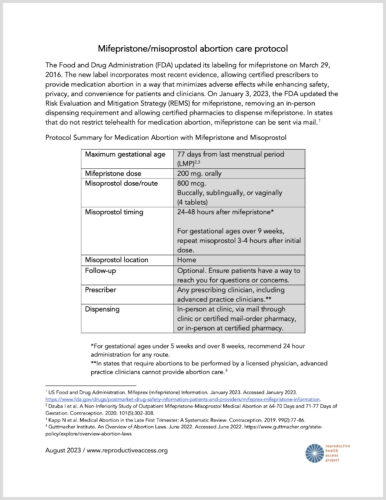
Protocol Comparison
  FDA regimen Updated regimen: Vaginal misoprostol Updated regimen: Buccal Misoprostol
Maximum gestational age 49 days from LMP 63 days from LMP 63 days from LMP
Mifepristone dose 600 mg. orally in office 200 mg. orally in office 200 mg. orally in office
Misoprostol dose 400 mcg. orally
(2 tablets)

800 mcg. vaginally
(4 tablets)

800 mcg. buccally
(4 tablets)

Misoprostol timing 48 hours after mifepristone 6-72 hours after mifepristone 24-36 hours after mifepristone
Misoprostol location Clinician’s office Home Home
Follow-up visit 14 days after mifepristone 5-14 days after mifepristone 5-14 days after mifepristone
Minimum number of office visits 3 2 2
Cost Higher Lower Lower
top of page  
Patient Referral

If you accept medication abortion referrals from your partners or colleagues, the following paragraph may be helpful to them: The primary provider should counsel his/her patient about pregnancy options and contraception. If the patient chooses medication abortion, she should receive an appointment with an appropriate provider as soon as possible. To avoid delays, a medication abortion provider should be contacted directly (by the primary provider or nursing staff) and a prompt appointment should be arranged.

top of page  
First Office Visit — Day 1

Counseling

1. Options counseling: Consider aspiration abortion and alternatives to abortion, including adoption. Advise that medication abortion has a failure rate (i.e. continuing pregnancy) of about 1 in 250 and an aspiration abortion may be needed in 1-3% of cases. Compared with aspiration abortion, medication abortion causes longer bleeding duration and more abdominal cramping. Medication abortion is non-invasive, avoids surgical and anesthetic risk, and can occur very early in pregnancy. It has been perceived by many patients to be more natural, and allows more privacy and control. (See consent form.)

2. Review of adverse effects: Bleeding and cramping (usually heavier than with menses) are expected. Diarrhea and other gastrointestinal side effects are common. There is a very small risk of prolonged bleeding requiring an aspiration abortion or MVA. The patient should be instructed in procedures to follow in case of an emergency.

3. Adherence to protocol: Explain to the patient the two-visit procedure and the importance of finishing the medication abortion protocol. If the abortion is unsuccessful, an aspiration abortion must be performed due to the possible teratogenicity of misoprostol.

Compliance with State Requirements

Many states have specific requirements affecting abortion. Most of these laws apply both to medication and aspiration abortion. Providers must comply with mandatory waiting periods, parental notification, gestational age limits, and department of health reporting as required. To find out more about these regulations, consult www.reproductiverights.org.

Medical History and Physical Exam

1. Confirm pregnancy with a urine pregnancy test.

2. Rule out contraindications:

IUD in place (may be removed prior to medication abortion)
Allergy to prostaglandins or mifepristone
Chronic adrenal failure
Long-term systemic corticosteroid therapy
Ectopic pregnancy
Hemorrhagic disorders
Concurrent anticoagulant therapy (excluding aspirin).

3. Ensure that the patient has access to a telephone and transportation, and that she agrees to return for follow-up appointments as needed.

4. Obtain a medical history and perform a focused physical exam. A bimanual exam should assist in gestational dating. Obtain a Pap smear and test for gonorrhea and Chlamydia infection (if indicated).

Dating Pregnancy

Ultrasound examination should be performed if gestational age is uncertain, if there is a size/date discrepancy, if sizing is difficult, if the patient’s last menstrual period occurred while she was taking hormonal contraception, or if the clinician suspects ectopic pregnancy. Although the FDA has approved medication abortion only for pregnancy up to seven weeks (49 days) gestation, there is now ample evidence that mifepristone/misoprostol-induced abortion is successful up to 9 weeks (63 days). Current evidence supports buccal and vaginal misoprostol administration up to 9 weeks.

Rh status, quantitative βhCG, hemoglobin measurements obtained
Rh status may be determined from a blood donor card, from the patient’s history, or by obtaining a new measurement. A quantitative bhCG level may be needed for comparison with a subsequent level. A baseline hemoglobin or hematocrit level can be ordered as well, especially if there is any history of anemia.

Review the required provider/patient agreement and the updated consent form.

Give medication and directions for misoprostol administration:
Buccal administration: The patient will administer four 200-microgram misoprostol tablets, holding two in each cheek for 30 minutes and then swallowing them with a drink, at a convenient time 24-36 hours after taking mifepristone.
Vaginal administration: The patient will place four 200-microgram misoprostol tablets in her vagina 6 - 72 hours after taking the mifepristone. She will then lie down for 30 minutes. If the tablets fall out after 30 minutes, they can be discarded.
If expulsion (i.e., cramping and bleeding) does not occur within 24 hours of the initial misoprostol dose, the patient should consult her provider. A second dose of misoprostol may be indicated.

Administer Rh-IG if indicated.Micro Rhogham will be used instead of the full dose and should be given prior to using the misoprostol or within 72 hours of bleeding. Patients should be informed that this medication is a human blood derivative. For patients who refuse the injection, a signed statement to that effect should be included in the chart. There is not good evidence that this injection is needed for very early pregnancies, and it is not used routinely in Europe. It is the tradition or “standard of care” in the US, however.

Advise patient on use of pain medications: Prescriptions for acetaminophen with a narcotic and/or Ibuprofen 800 milligrams should be offered to the patient. Patients should be encouraged to fill the prescription/s in advance and to have the pain medications on hand to be taken as needed.

Make sure patient knows how to reach provider on-call. An information sheet with instructions about how to call or page the provider should be given to each patient, and the information should be reviewed to be sure she understands. The patient should be instructed to call her provider if she does not bleed within 24 hours of using the misoprostol, if bleeding exceeds two maxi-pads per hour for two consecutive hours, or if she begins to feel very ill at any time during the medication abortion process.

Administer mifepristone: 200-milligram tablet by mouth.

Review plans for post-abortion contraception: Patients who choose oral contraceptives may begin the pill on the most convenient day (often Sunday) after taking misoprostol – even if they are still bleeding. Depot progestin (Depo Provera) injection or IUD insertion can take place at the follow-up visit. Patients may begin to have sex with barrier contraception after 72 hours. Patients who choose tubal ligation should be referred as appropriate to avoid delays.

top of page  
Second Office Visit — Day 5-14

Follow-up visit to assess completeness of abortion

1. To assess the completeness of the abortion, providers should use the following criteria:

  • history (patient's description of bleeding — which should be at least as much as her menses — with cramping and passage of clots);
  • declining ßhCG levels and/or ultrasound.

2. If pregnancy is ongoing, i.e. a rising βhCG or a sonogram with a growing pregnancy, an aspiration completion can be performed. If the abortion is incomplete (i.e. a sonogram showing no interval growth and no fetal heartbeat), the patient can choose a repeat dose of vaginal misoprostol or an aspiration procedure.

3. All test results (Pap, GC, and Chlamydia) should be available, and results should be reviewed with the patient and managed appropriately.

4. The contraception plan should be reviewed and confirmed.

Further follow-up

Patients should be instructed to call or return if bleeding persists beyond 4 weeks or becomes heavy again.
top of page  
Chart Review Form: Medication Abortion
  Yes No N/A
Options counseling documented      
Adverse effects education documented      
Protocol explanation documented      
Informed consent form: In chart      

Labeled


Signed

     
Rh status documented      
Rhogam given (if indicated)      
Initial Beta-HCG level documented      
Hemoglobin level documented      
Pain medication prescribed      
Follow-up visit completed      

Assessment of abortion completion documented:

History


Beta-HCG level


Sonogram

     
Contraception plan documented      
Pap smear result documented (if applicable)      
Gonorrhea and Chlamydia results documented
*Appropriate treatment offered (as indicated)
     
top of page  
Checklist for Medication Abortion with Mifepristone

Patient Name: __________________________

Chart Number: __________________________

  Yes No N/A
Options counseling documented      
Adverse effects explained      

Protocol explained:

Timing of medications


Need for follow-up visit


On-call system


Contraindications ruled out:

No IUD in place


No allergy to prostaglandins/mifepristone


No chronic adrenal failure


No long-term systemic corticosteroid tx


No concurrent anticoagulant therapy


No ectopic pregnancy


No hemorrhagic disorder

     
Mifeprex medication guide given      
Mifeprex provider/patient agreement signed      
Informed, evidence-based consent form signed      
Rh status (circle one): Positive / Negative      
Rhogam given (if indicated)      
Initial beta-HCG level: ____________      
Hemoglobin level ____________      
Ultrasound dating done      
Pain medication prescribed      
Mifeprex lot number recorded:
____________date administered:
     
Follow-up visit completed on: ____________      

Abortion completion assessed by:

History


Beta-HCG level


Sonogram

     
Contraception plan reviewed      
 

DOWNLOAD PDF:
ENGLISH

DOWNLOAD WORD DOCUMENT
ENGLISH

These forms are not intended to provide legal, medical or other professional advice. They are not a substitute for consultation with a healthcare provider or for independent judgment by healthcare providers or other professionals regarding individual conditions and situations.
Twitter facebook
Site Index Terms of Use Privacy Policy